

Start with the problem, not the label
"AI operating system" is an overloaded label. It can refer to an agent runtime, an orchestration layer, a persistent data-and-action environment, a governance layer, or simply a product category. That ambiguity makes it a poor starting assumption for architecture work.
Decision Crafters uses the term more narrowly as a working research pattern: a stateful operating model that can make identity, actors, persistent state, policies, permissions, authority, workflows, AI reasoning, evidence, decision memory, review, and learning explicit when a use case actually needs them.
An AI operating system should be an architectural conclusion, not a starting assumption.
The building blocks already exist
There is no credible basis for claiming that the underlying components are novel. Current platforms already combine many of them. Microsoft describes Dataverse as an operational database for agents and emphasizes business processes plus human oversight. Microsoft Fabric Ontology (preview) models business entities, relationships, constraints, and rules. Palantir's Ontology represents objects, links, actions, functions, and security over operational state. OpenAI's Agents SDK supports persistent sessions and human-in-the-loop interruption and resumption. Google's AI Studio/Firebase integration can add persistent Firestore data and authentication to generated applications.
The architectural question is therefore not whether these components exist. It is whether a particular business problem needs enough of them together to justify a richer operating-system pattern.
A practical suitability test
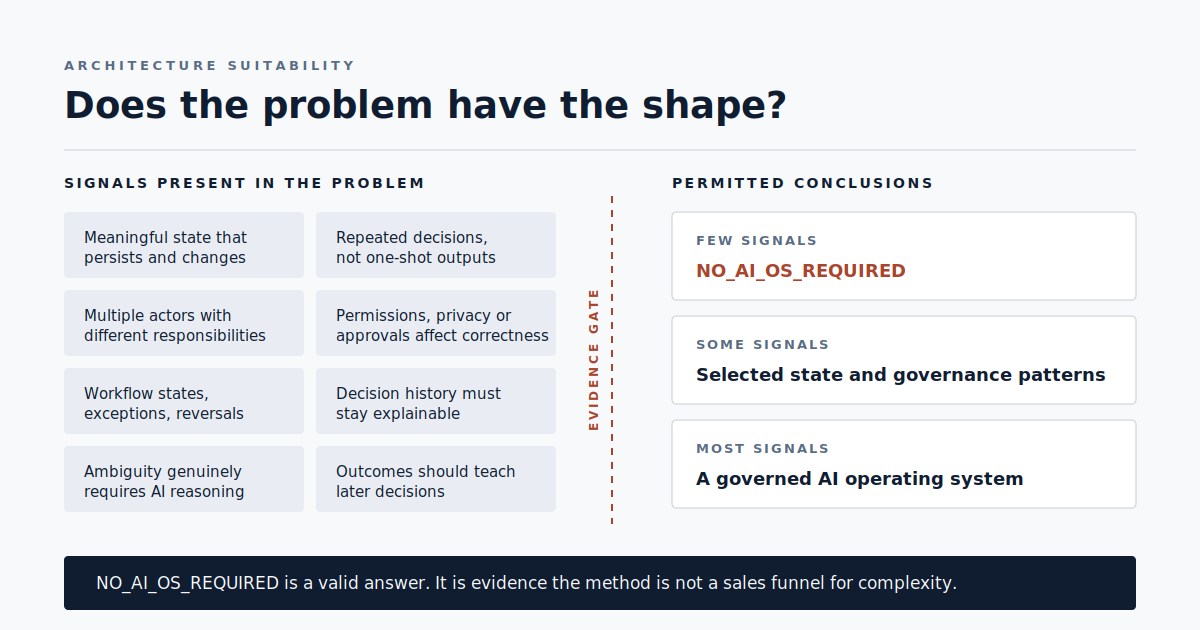
A problem becomes a stronger candidate when several conditions are present: persistent state changes materially over time; the system participates in repeated decisions rather than one-shot answers; multiple actors or roles matter; privacy, authority, or approvals matter; work moves through recurring states and exceptions; the organization needs decision memory or auditability; ambiguous inputs genuinely benefit from AI reasoning; and outcomes should inform later decisions through a governed review loop.
By contrast, a task with little persistent state, no recurring operating cycle, no meaningful authority boundary, and no need for decision history may simply need a tool.
When a smaller system is better
A one-shot document summarizer does not need an AI operating system merely because a model is involved. A bounded retrieval assistant may need permissions and source controls but not a full operating model. A deterministic workflow can remain deterministic if AI adds no useful ambiguity reduction.
Now consider a procurement-exception process. If each exception is a persistent case with evidence, policy thresholds, multiple reviewers, approvals, deadlines, reversals, and later audits, then the problem begins to look different. The architecture may need durable state, actors, policy, authority, AI-assisted classification, evidence lineage, and a record of the final human decision.
The point is not the label. The point is the shape of the problem.
"NO_AI_OS_REQUIRED" is a valid answer
A framework-neutral architecture review should be allowed to recommend preserving the current architecture, repairing one component, adding a bounded AI feature, using a conventional workflow engine, adopting selected state/governance patterns, or using a fuller AI-OS pattern only when the evidence justifies it.
It must also be allowed to return NO_AI_OS_REQUIRED.
That answer is not a failure of the method. It is evidence that the method is not being used as a sales funnel for complexity.
A nine-question decision sequence
- Does meaningful state persist and change over time?
- Are there recurring decisions, not just one-shot outputs?
- Do multiple actors or roles have different responsibilities?
- Do permissions, privacy, or approvals materially affect correctness?
- Are there workflow states, exceptions, reversals, or deadlines?
- Does ambiguity genuinely require AI rather than deterministic logic?
- Must the decision history remain explainable or auditable?
- Should outcomes teach future decisions through a governed review process?
- What is the simplest competing architecture, and why is it insufficient?
The architecture should be allowed to get smaller
Every additional agent, memory layer, orchestration component, policy surface, database, and integration creates cost and failure modes. Complexity must earn its place.
A sound architecture process therefore optimizes for the smallest governed system that solves the real problem—not for the largest AI stack that can be justified rhetorically.
Decision implication
The meaningful question is not "Do we have an AI OS?" It is "What is the smallest governed operating structure this problem actually requires?"
Request a Fit Conversation for an architecture decision that is still ambiguous →
Read next: From business problem to governed AI system · Where more AI stops helping: The AI–human breakpoint
Related: The Diagnostic · Our method and evidence standard