

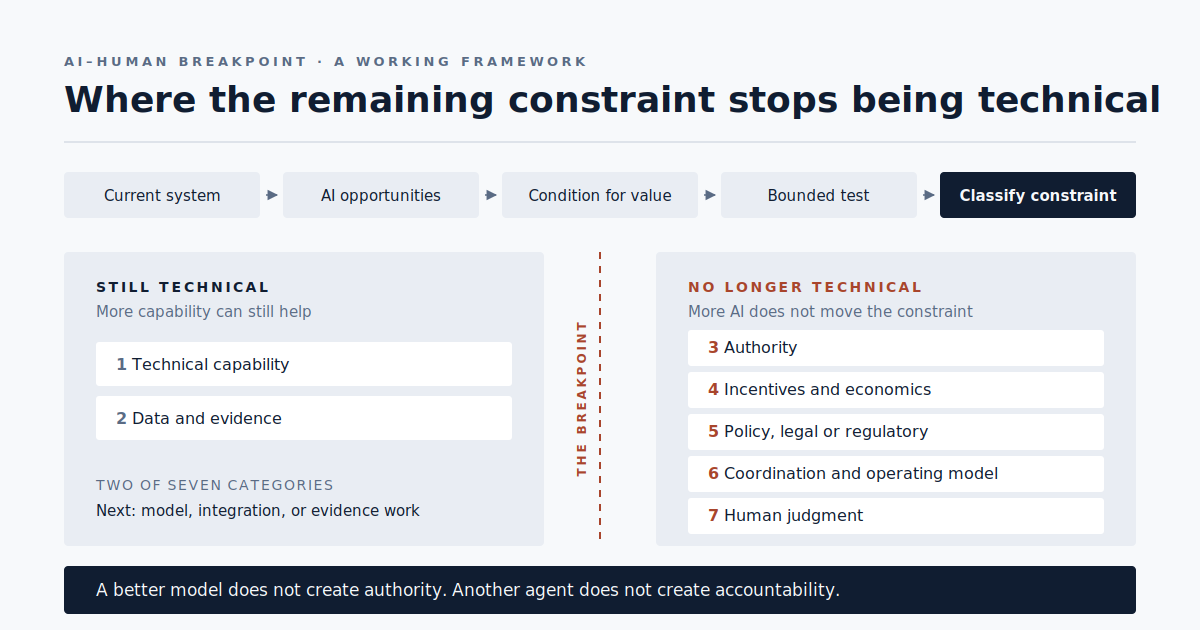
More capability is not always more decision value
Suppose the model becomes more accurate, the agent gets more tools, and the workflow becomes faster. What constraint remains?
Sometimes the remaining constraint is technical. Sometimes it is data quality. But in consequential business systems, the binding constraint may be authority, incentives, economics, policy, regulation, ownership, trust, coordination, or human judgment.
Decision Crafters uses "AI–human breakpoint" as a working internal framework for locating that transition. It is not yet a validated market category or a claim of universal applicability.
AI systems are socio-technical systems
NIST AI RMF 1.0 and its current Playbook treat AI risk in context: organizations are expected to define human roles, document oversight, assess impacts, and make go/no-go decisions rather than treating model performance as the entire system.
That matters because an AI recommendation can be accurate but unactionable. An automation can be fast but unauthorized. A prediction can be useful but uneconomic. An agent can technically execute a task without having legitimate delegated authority to do so.
The architecture question is therefore not simply, "Can AI do this?" It is, "What must also be true for this capability to create decision value?"
Seven breakpoint categories
- Technical capability — the model, runtime, integration, or reliability is the limiting factor.
- Data and evidence — the system cannot obtain sufficiently trustworthy, timely, or attributable evidence.
- Authority — the action requires a decision right the system does not hold.
- Incentives and economics — the technical solution works but the cost, benefit, or incentives do not support adoption.
- Policy, legal, or regulatory constraint — the action is bounded by rules outside the model.
- Coordination and operating model — ownership, handoffs, sequencing, or organizational design prevent value realization.
- Human judgment — the remaining decision depends on normative judgment, accountability, negotiation, or context that should remain with people.
How to locate the breakpoint
A disciplined review can follow a simple sequence:
current system → AI opportunities → condition for value → bounded test where useful → classify the remaining constraint → choose the matching next action.
The key is to avoid treating every failed AI outcome as evidence that the model needs to improve. If the failure is an authority problem, a better model does not create authority. If it is an ownership problem, another agent does not create accountability. If it is an economic problem, more automation does not make the unit economics attractive by itself.
Three hypothetical examples
HYPOTHETICAL — Invoice anomaly detection: an agent reliably detects a suspicious invoice and assembles evidence. The remaining decision is whether finance or procurement has authority to hold payment and who is accountable for false positives. The breakpoint is authority and operating process, not detection accuracy.
HYPOTHETICAL — Incident summarization: a model produces excellent incident summaries. The organization still loses time because ownership for follow-up actions is unclear across engineering teams. The breakpoint is coordination, not language generation.
HYPOTHETICAL — Employee-retention analysis: a model improves identification of attrition risk. The actual intervention is constrained by budget, policy, fairness considerations, manager judgment, and whether the organization can act on the signal. The breakpoint may be economics, policy, or human judgment rather than prediction quality.
The executive question map changes at the breakpoint
For the CIO or CTO: is a technical system still limiting the outcome?
For the COO: is the operating model, handoff, or ownership structure the real constraint?
For the CFO: do the economics support the intervention?
For risk, legal, or compliance: is the proposed action authorized, reviewable, and properly recorded?
For the CEO: what consequential decision and accountability still belong to a human executive?
The same AI capability can therefore create different decisions for different functions.
Knowing when to stop can save more than knowing what to automate
A team can waste significant effort optimizing a model after the model is no longer the bottleneck. The breakpoint framework is meant to redirect that effort toward the actual constraint.
Sometimes the right next step is a model change. Sometimes it is better evidence. Sometimes it is a redesigned approval path, a clearer owner, a policy decision, a smaller workflow, a human review, or no further AI investment.
The value is not in declaring that AI has limits. That is obvious. The value is in locating the specific limit that changes the next executive decision.
Decision implication
Before adding another model, agent, or automation layer, identify the condition that must be true for the current capability to create value. Then test whether the remaining constraint is actually technical.
Request a Fit Conversation for the AI & Platform Architecture Diagnostic →
Read next: Does This Business Actually Need an AI Operating System? · From business problem to governed AI system
Related: The Diagnostic · Our method and evidence standard