

When a prototype tells you to stop building
A useful prototype does not always tell you what to build next. Sometimes its most important result is showing you where software should stop.
Decision Crafters reached that point while using a bounded reference application to explore shared financial coordination. The application represented recurring decisions, agreements, privacy boundaries, approvals, disagreements, and persistent memory. Technically, none of those concepts was exotic. The harder problem appeared when the system moved from remembering a decision to enforcing one.
That change sounds small. Architecturally, it is not.
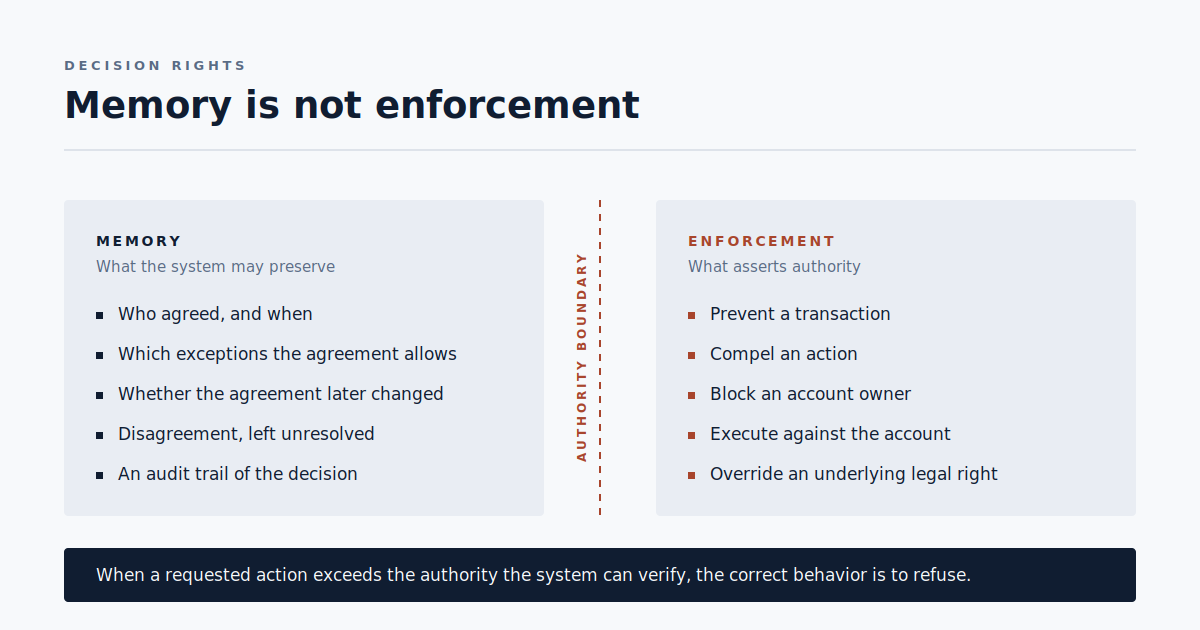
A system can record that two people agreed to a spending rule. It can preserve who agreed, when they agreed, what exceptions were allowed, and whether the agreement later changed. It can remind people that a decision exists. It can surface a disagreement. It can require multiple people to approve an application-level workflow.
But the moment software attempts to make the agreement binding against an underlying financial account, the system is no longer just organizing information. It is asserting authority.
The missing primitive was not another model. It was governance.
Memory is not enforcement
A useful distinction emerged from the reference application: memory preserves facts, agreements, exceptions, decisions, and state; enforcement prevents, compels, blocks, or executes action. Those are different architectural responsibilities.
For example, the Consumer Financial Protection Bureau says that, in most circumstances, either owner of a joint checking account can withdraw money and close the account, while also advising consumers to check the account agreement and applicable state law. That narrow fact matters because an application-level agreement between two people does not automatically rewrite the underlying rights attached to the financial account.
That does not mean software has no role. It changes the role.
A governed system can preserve decision memory. It can require explicit application-level approvals before taking an action that the application itself controls. It can present privacy-aware views. It can represent unresolved disagreement instead of silently collapsing it into a recommendation. It can preserve an audit trail. And it can refuse to execute when the requested action exceeds the authority the system can safely verify.
This is a more restrained design than "automate the household." It may also be a better one.
Authority is part of the architecture
AI-system design often starts with capability questions: Can the model classify this? Can the agent call the tool? Can the workflow complete the task? Can the application persist the state?
For consequential systems, a second set of questions matters just as much: Who may see this state? Who may recommend a change? Who may approve it? Who may execute it? Who may reverse it? What happens when authorized participants disagree? What evidence must survive after the action?
These are not administrative details to add after the AI is working. They are architectural constraints.
NIST AI RMF 1.0 and its current Playbook reinforce that point. Its governance guidance calls for organizations to define and differentiate human roles and responsibilities in human-AI configurations, document oversight processes, and consider the social and organizational context in which AI operates. Its measurement guidance also asks organizations to evaluate oversight, overrides, errors, and go/no-go decisions.
The implication is practical: before granting an AI system more autonomy, define what authority the system is actually allowed to exercise.
The AI story and the human story
The reference application was useful because it connected a technical question to a human one. The technical story was about persistent state, approvals, privacy, decision memory, and AI-mediated workflows. The human story was about rights, incentives, vulnerability, disagreement, and the limits of delegated authority.
Neither story is sufficient alone. A technically capable system can still be wrong if it automates the wrong authority relationship. A careful governance policy can still fail if the application cannot preserve state, distinguish actors, or reconstruct how a decision was made.
The design target therefore is not maximum automation. It is the smallest system that can improve the decision while preserving the right human boundary.
A reference application can be valuable even when you decide not to ship it
This is one reason Decision Crafters treats reference applications as research instruments rather than automatic product candidates. A bounded implementation can reveal a missing state transition, an authority conflict, a privacy boundary, a disagreement that cannot be safely resolved by software, an institutional dependency outside the application, an enforcement action that should remain human-controlled, or a point where the correct system behavior is abstention.
A failed-to-instantiate primitive can be a finding.
That changes the purpose of prototyping. The question is no longer only, "Can we make the application work?" It becomes, "What did making the application concrete teach us about the real operating system around the problem?"
What technology leaders should ask
- What must the system remember over time?
- Which state is machine-generated, inferred, or human-confirmed?
- Who holds each decision right?
- Which actions require one human, multiple humans, or external authority?
- How should the system represent disagreement?
- What evidence must survive the decision?
- Is the remaining constraint software—or policy, governance, contracts, incentives, coordination, or judgment?
If those questions change the architecture, that is not a detour from the AI work. It is the AI work.
Decision implication
The strongest AI architecture is not necessarily the one that automates the most. It is the one that knows what it can safely remember, recommend, execute, and refuse.
That is the kind of boundary an AI & Platform Architecture Diagnostic should make visible before an organization commits to more agents, more integrations, or a larger automation surface.
Request a Fit Conversation for the AI & Platform Architecture Diagnostic →
Read next: Where more AI stops helping: The AI–human breakpoint · From business problem to governed AI system
Related: The Diagnostic · Our method and evidence standard