

A production-readiness case study in chained trust failures
Security incidents are often described by their first exploit. Production risk is better understood by what that exploit enables next. Railway's detailed November 10 account of its October 20–21 security incident is valuable because it exposes a chain of boundary crossings, from build isolation into internal services, deployment identity and sensitive configuration. The incident is not just a story about a vulnerability. It is a case study in how one compromised credential can become a route to a different and more powerful credential.
The Pragmatic Engineer's November 12 Pulse raised the question of what engineers can learn from the Railway hack. This Decision Crafters analysis works from Railway's public forensic account rather than treating subscriber-only commentary as independently inspected evidence.
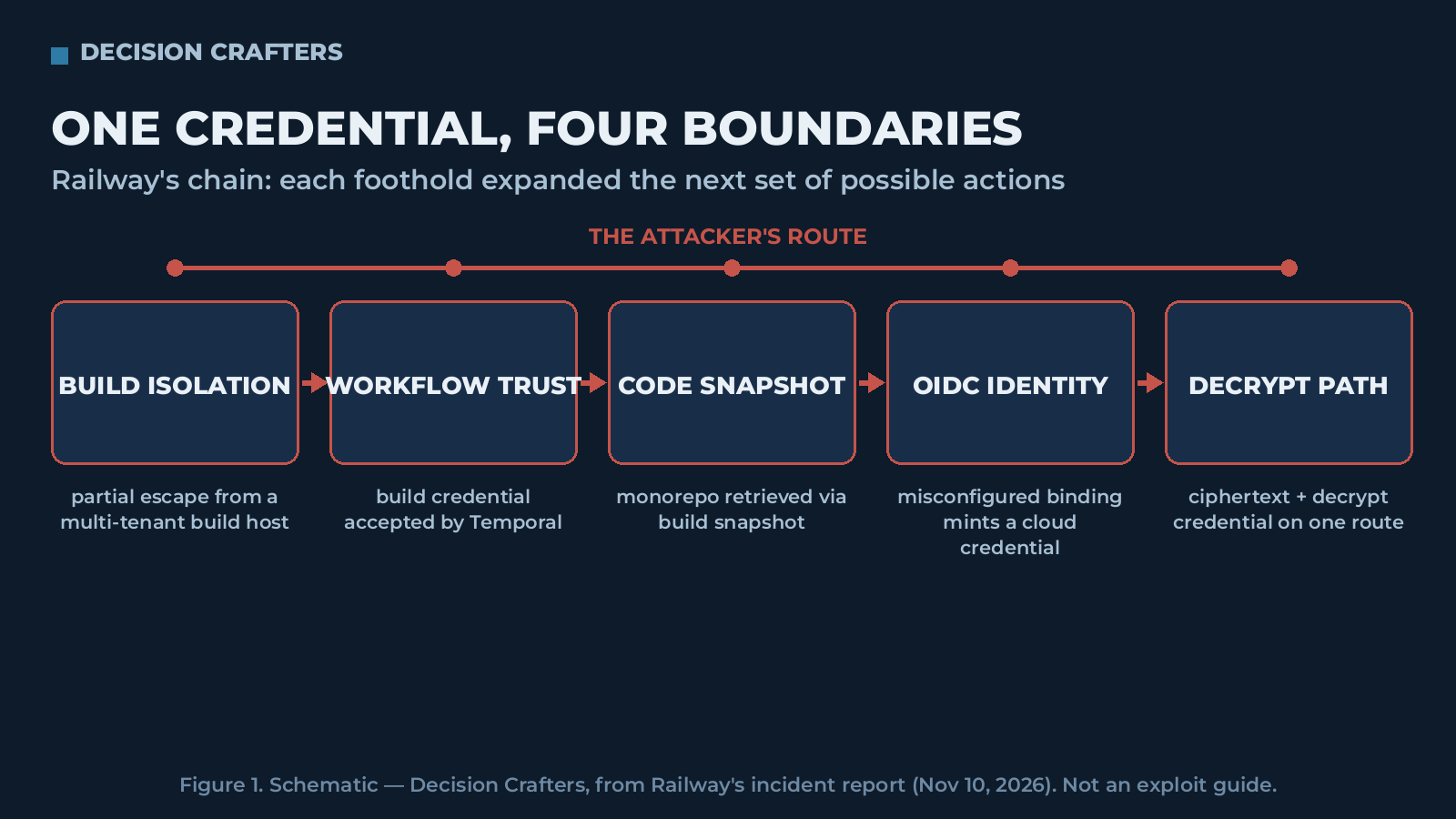
Figure 1. One credential, four boundaries: the Railway chain as a sequence of trust-boundary crossings. Schematic — Decision Crafters, from Railway's incident report (November 10, 2026).
The chain: build isolation, workflow trust, deployment identity
According to Railway, an attacker first exploited a previously unknown flaw in its multi-tenant build environment that permitted a partial escape from filesystem isolation. That access exposed a build credential. The credential was intended for limited build-related operations, but Railway's self-hosted Temporal workflow infrastructure trusted it in ways that allowed access to some build histories and related information. The actor then obtained a copy of Railway's internal monorepo through a build snapshot route.
This changed the nature of the attack. Railway reports that the actor used knowledge from the codebase to probe other internal paths. A misconfigured OIDC binding for a CI/CD workflow subsequently allowed the actor to obtain a short-lived cloud credential. They used further credentials to access an orchestration machine and systems involved in decrypting stored environment variables. Railway says logs showed queries prioritizing AI-provider keys; it assessed the attackers' likely objective as credential theft for later misuse. That assessment is attributed to Railway, not independently established attribution or motive.
No one step tells the whole story. The key architectural failure mode is privilege transitivity: authorization granted for one purpose was usable across another trust boundary, and each new foothold expanded the next set of possible actions.
Why "encrypted secrets" were not the end of the risk
Railway's variable storage used per-environment encryption keys wrapped by an upstream key-management root key. That segmentation was a real boundary, but the attacker reportedly gained access to both encrypted records and the credentials needed for decryption in the affected path. Encryption is not an independent defense when an attacker can invoke the authorized decryption service from a compromised identity and network position.
Railway says at most 1.85% of workspaces — approximately 100,000 — could have had environment variables decrypted. This is an upper bound based on its logs, not a claim that every variable in those workspaces was stolen or that every customer suffered misuse. The report separately identifies 1,852 users whose linked-account tokens were exposed and reset. These distinctions matter: count potentially exposed scopes, confirmed decryption pathways, and observed downstream misuse separately.
Three architecture decisions exposed by the incident
First, build workers are part of the security perimeter. Treat developer-controlled build inputs as untrusted. Test isolation, reduce host-readable material, keep credentials scoped to exactly what build completion requires, and restrict reachable internal services. A container boundary that looks adequate for workload isolation may not be an adequate boundary around credentials or control-plane APIs.
Second, credentials must not inherit authority from the system that holds them. Verify every CI/CD trust relationship, especially OIDC audience, subject and repository/workflow conditions. A short-lived token narrows the exposure window but cannot compensate for an overly broad identity binding. Test whether a compromised build identity can address workflow orchestration, artifact stores, deployment backends and secrets APIs outside its purpose.
Third, key management must be evaluated as an end-to-end path. Encrypting variables is necessary, but where can they be decrypted? Which operators and hosts can reach the store and key service? Can a compromised orchestration node combine ciphertext access with decrypt permission? Can you revoke credentials and continue serving customers? The answers depend on reachable paths, not the presence of a KMS logo on a diagram.
The incident-response tradeoff is a product decision
Railway reports halting builds twice, rotating infrastructure credentials, invalidating user sessions and tokens, rebuilding internal tooling from trusted sources, and restoring builds for all plans by October 22 at 22:49 UTC. During part of this response, existing customer workloads continued running. That distinction illustrates a deliberate operational tradeoff: pause the system's ability to build or deploy while preserving already-running services where possible.
A resilient platform should decide those break-glass states before an intrusion: which control-plane functions can be suspended independently of customer data-plane traffic, how secret rotation cascades through services, which credentials must be mass-revocable, and how recovery can proceed when the CI/CD system itself is not trusted.
What the evidence does and does not establish
Railway describes a fast-moving attacker and refers to AI-assisted activity and external security reporting. This record should not be reduced to "AI hacked Railway." The directly actionable engineering lessons remain valid without proving which models, tools or individuals conducted each step. Equally, an incident report authored by the affected provider is a primary source with substantial detail, but not a substitute for an independent forensic audit. Where the report states belief, upper bound or absence of indications, preserve that uncertainty.
The strongest production-readiness question is therefore not "Would this vulnerability affect us?" but "If our least-trusted build process leaked one credential, which independent barriers would prevent the next three pivots?" Model the path, prove the boundaries and exercise the recovery plan. The attacker needs one chain; defenders need to know where it breaks.
A four-question preflight
Can a build identity query orchestration histories for another workload? Can a deployment credential be minted outside its exact trusted workflow claims? Can one reachable host both obtain ciphertext and request decrypt? Can builds be stopped and credentials revoked without taking down healthy running services? If the answers are unknown, you have work to do before the next release.
Sources and evidence boundaries
Primary source: Railway, "Incident Report: October 21st Security Attack," Nov 10, 2026 (last updated 18:02 UTC): https://blog.railway.com/p/incident-report-october-security-incident
Editorial prompt/reference: Gergely Orosz, The Pragmatic Engineer, "The Pulse: What can we learn from the Railway hack?", Nov 12, 2026: https://newsletter.pragmaticengineer.com/s/the-pulse (subscriber-only analysis; not represented as fully reviewed)
Limits: Railway-authored investigation, conditional estimates and attribution. DC's control checklist and argument are independent synthesis; this is not independent breach attribution.